Overview
Sustainability disclosure has expanded faster than its quality, structure and standardisation. Regulators, investors and civil society increasingly rely on it, yet questions remain about why firms report the way they do and what that reporting achieves.
My empirical-archival work engages with these questions. I study the determinants and consequences of corporate sustainability reporting using large corpora of text and computational methods, such as natural language processing in Python and, increasingly, large language models, to turn unstructured disclosure into data that can be analysed econometrically. Together with Prof. Peter Limbach I have built a corpus of more than 30,000 sustainability reports from European and U.S. firms, which underpins most of my current pipeline.
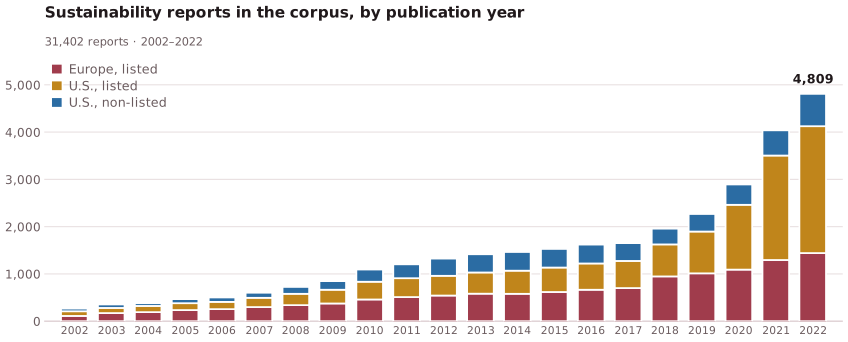
The corpus. 31,402 sustainability reports covering years 2002 to 2022, assembled with Peter Limbach and funded through Bielefeld’s Qualitätsfonds plus. European listed firms account for 12,420 reports and U.S. listed firms for 12,967. The third group is the one that is rarely studied: 6,015 reports from non-listed U.S. firms, which are the basis of Sustainability Reporting by U.S. Private Firms. Over half the corpus was published in the final five years of the sample.
Job market paper
Philanthropic Disclosure and Political Insiders
with Vanessa Flagmeier · Revise & resubmit (second round), Journal of Accounting Research
Do political incentives shape philanthropic disclosure? We find that German savings banks disclose more politically associated philanthropy in election years, and that the effect is not fully explained by an increase in philanthropic expenses — pointing towards strategic disclosure rather than strategic giving. Using named-entity recognition to extract and classify the organisations mentioned in banks’ local press disclosures, we show that philanthropic disclosure increasingly references organisations salient to the relevant voter base, and that higher disclosure is associated with larger subsequent vote margins. The electoral cycle provides exogenous variation in insider incentives, giving the design strong internal validity.
Earlier version (TAF Working Paper) · current draft available on request
Peer-reviewed publications
The Role of Stakeholders in CSR Reporting of Non-Listed Banks. Gulenko, M., Kohlhase, S., & Kosi, U. (2026). Accounting in Europe, 1–35. [DOI]
German savings banks are established by municipal trustees and serve clients in a sharply defined operating area, which makes their stakeholders unusually observable. We exploit the reporting discretion under the Non-Financial Reporting Directive, which should translate differences in stakeholder interests into visible variation in disclosure and find that CSR reports and individual CSR dimensions are associated above all with strong CSR governance, such as the presence of a CSR manager. While municipal trustees and clients do matter, their interests are more strongly reflected in reporting where such governance structures are in place.
To the Moon! Analyzing the Community of “Degenerates” Engaged in the Surge of the GME Stock. Caron, M., Gulenko, M., & Müller, O. (2021). ICIS 2021 Proceedings. [Paper] · Nominated for Best Paper
In early 2021 the GameStop share price rose 2,442% in four weeks, a surge widely attributed to retail investors coordinating on the r/wallstreetbets subreddit. Drawing on 4.9 million posts and comments, we ask whether activity in that community tracks the stock’s trading volume. It does: user activity is associated with GME trading volume, and posts carry significantly more predictive power than comments, particularly for days of unusually heavy trading. The findings matter for trading platforms, institutional investors and regulators, for whom coordinated retail attention is a source of disruption rather than noise.
Mandatory CSR Reporting — Literature Review and Future Developments in Germany. Gulenko, M. (2018). Sustainability Management Forum, 26(1), 3–17. [DOI]
Reporting mandates for corporate social responsibility have spread across jurisdictions, and this review asks what the early evidence says they achieve. The literature points consistently in one direction: mandatory reporting does change reporting behaviour — more firms report, and at greater length — but the additional quantity is not matched by quality. The second-order consequences of that changed behaviour, at company, investor and society level, had largely not been addressed yet. Applied to the German implementation of the NFRD, this suggests firms will widen the range of topics they cover, possibly at the expense of depth.
Book chapters
Nachhaltigkeitsbezogene Offenlegungen (Chapter 22). Sopp, K., & Gulenko, M. (forthcoming). In Knesl, Renner, Eberhartinger & Schiebel (Eds.), Die Bankbilanz.
The EU’s 2018 Action Plan on Financing Sustainable Growth has produced a dense and still-shifting body of disclosure law for banks and insurers. This chapter sets out that framework in five blocks: Reporting duties under the Taxonomy and Disclosure Regulations; sustainability reporting under the CSRD and the ESRS; the treatment of ESG risks in banking supervision; sustainability preferences in investment and insurance advice, and product governance; and the EU climate benchmarks. It provides an overview of mandates that are otherwise scattered across regulations and delegated acts.
Working papers
Sustainability Reporting by U.S. Private Firms — with Gerrit Köchling and Peter Limbach
Roughly 75–80% of U.S. workers are employed by privately held firms, yet almost everything known about sustainability reporting comes from listed companies. Using 5,775 reports from U.S. private firms and 8,298 from public firms over 2002–2022, we provide the first large-scale evidence on how private firms report. Conditional on emissions intensity, they enter reporting at much the same time as public firms, but tilt their content toward non-material environmental topics and treat public-firm reports as informal templates. Going public is associated with a gradual increase in the likelihood of publishing a sustainability report and a shift toward investor-oriented reporting frameworks. Draft available on request.
Lighting the Green: The Role of Green Bond Sections in the European Market — with Pia Stoczek
Green bond sections are dedicated lists on European trading venues for bonds meeting specific disclosure and review requirements: a market-led institutional response to greenwashing. Using bid-ask spreads to proxy for information asymmetry, we find that listing on a green bond section is associated with narrower spreads, concentrated among bonds with higher baseline information asymmetry and venues with stringent disclosure requirements. A mediation analysis suggests the effect does not operate through the quality of issuers’ textual disclosure, but rather through the monitoring and credibility signal of the listing itself. Draft available on request.
Research in progress
Mimicking Behaviour in Sustainability Reporting — with Peter Limbach
Sustainability reporting in the United States is largely unregulated, so any convergence across reports reflects firms’ own choices. From a directional firm-pair panel of 3.9 million observations covering stand-alone reports from 2007 to 2021, with similarity measured through document embeddings, we ask whom firms imitate and to what effect. Firms move toward high-status, information-rich templates, i.e., same-industry peers, S&P 500 constituents, experienced reporters, highly rated firms, most sharply after ESG incidents, after a first-time ESG rating, and under new CEOs. Convergence narrows ESG rating disagreement but predicts no change in incidents or emissions.
Corporate Volunteering — with Daniel Alayou, Peter Limbach and Noah Starke
We extract information on corporate volunteering programmes from corporate sustainability reports, a widespread form of corporate social engagement that has not so far been measured at scale, and ask what drives firms’ decisions to engage and to disclose, and whether engagement is associated with productivity.
Presentations
Academic
2026 EAA Congress (Prague University of Economics and Business); VHB Annual Conference (University of Göttingen)
2025 Research Seminar (Bielefeld University)
2024 Research Seminar (Bielefeld University)
2023 EAA Congress (Aalto University School of Business); invited Research Seminar (LMU Munich)
2022 Interdisciplinary Conference on Intangibles and Intellectual Capital (Taormina)
2021 Banken-Forschungsworkshop (University of Münster)
2019 EUFIN (Vienna University of Economics and Business); Annual Conference on Financial Reporting and Business Communication (University of Reading); Faculty Research Workshop (Paderborn University)
Practitioner
2025 Invited talk, construction industry firm; research presentation to regional sustainability managers
2024 Research presentation to regional sustainability managers (practitioner workshop — organiser and speaker)